Block Board — What It Is, Uses & Price
Block board solves a specific structural problem plywood sometimes struggles with — genuine rigidity over long, unsupported spans. Here’s what it’s made of and where that particular strength genuinely matters.
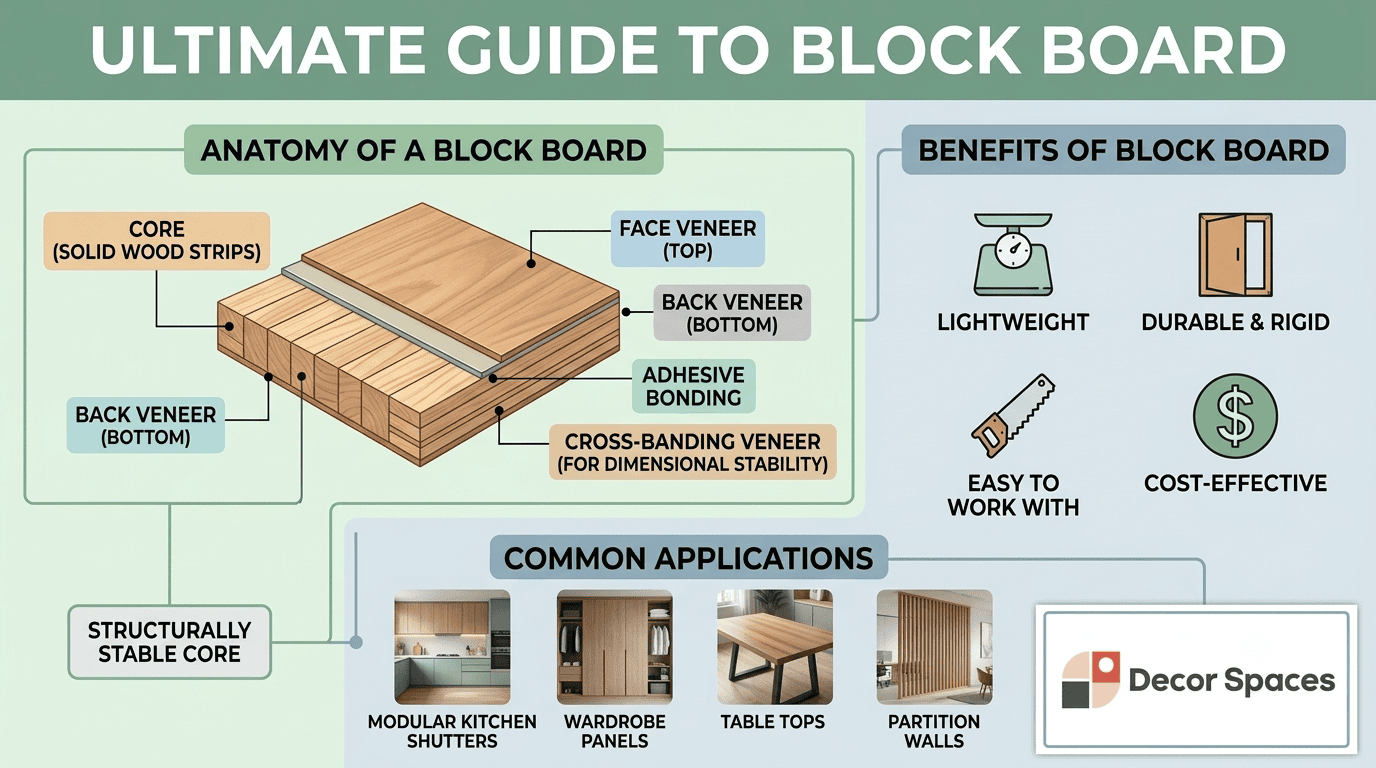
Block board has a core of solid wood strips sandwiched between veneer layers, giving it notably better rigidity over long spans than standard plywood. It costs ₹70–110/sq ft and genuinely earns its place for large shelves, table tops and door panels.
Block Board: What It’s Actually Made Of
Block board’s construction genuinely differs from plywood‘s thin-layer approach: a core of solid wood strips, typically 25-75mm wide, glued edge to edge, then sandwiched between two outer veneer layers for a smooth finished surface. This solid-strip core is what gives block board its distinctive structural characteristic — genuine resistance to bending over long spans that thin-layered plywood of the same thickness can lack.
Block Board: Where That Rigidity Genuinely Matters
- Large shelving spans — a wide bookshelf or wardrobe shelf without intermediate support holds its shape better with block board.
- Table tops and desk surfaces — resists warping over a large, unsupported flat area.
- Full-height door panels — genuine dimensional stability over a tall, narrow panel.
- Large flush doors — a common, well-suited application given the rigidity-to-weight balance.
Not sure if block board or plywood better suits your specific application? We’ll give an honest recommendation.
See our interior design services →Block Board vs Plywood: The Honest Trade-Off
| Factor | Block Board | Plywood |
|---|---|---|
| Long-span rigidity | Better | Good |
| Moisture resistance | Moderate | Better (grade-dependent) |
| Strength consistency | Direction-dependent | More uniform |
| Weight | Generally lighter | Denser |
Block board’s solid-strip core means its strength varies slightly depending on the direction relative to the strips, whereas plywood’s cross-grained layers give more uniform strength in every direction. For most cabinetry work, this distinction matters less than the long-span advantage block board offers for specific large, flat applications.
If the piece involves a large, relatively unsupported flat span — a wide shelf, a table top, a tall door — block board’s rigidity is a genuine, meaningful advantage. For general cabinetry, wardrobe carcasses, and moisture-prone areas, standard plywood grades remain the more versatile, better-tested choice.
For the layered-veneer alternative in full detail, see our plywood guide, or for the compressed-fibre family, our MDF guide.
Get the right board specified for every application — large spans included.
Book Free Site Visit →FAQs
What is block board made of?
A core of solid wood strips, typically 25-75mm wide, glued edge to edge, sandwiched between two outer veneer layers. This differs from plywood’s thin veneer layers throughout, giving block board higher rigidity over long spans.
Is block board better than plywood?
Block board holds screws well and resists bending over long spans better than standard plywood, making it strong for large shelves and door panels. Plywood generally offers better moisture resistance and more consistent strength in all directions.
What is the price of block board?
Typically ₹70–110/sq ft depending on thickness and core wood quality, generally comparable to or slightly less than standard plywood grades.
Related reading: Plywood guide · MDF guide · Particle board guide