Gypsum False Ceiling vs POP — Which is Actually Better?
Almost every homeowner planning a false ceiling ends up asking the same question: gypsum or POP? Both create that clean, layered ceiling look, both hide wiring and AC ducting, and both come recommended by different contractors — usually whichever one they’re set up to install. Here’s an honest, materials-first comparison to help you actually decide.
For most Chennai homes, gypsum false ceiling is the better default — lighter, faster to install, and more consistent in humidity. POP earns its place when you want elaborate curved or moulded designs that gypsum board simply can’t achieve.
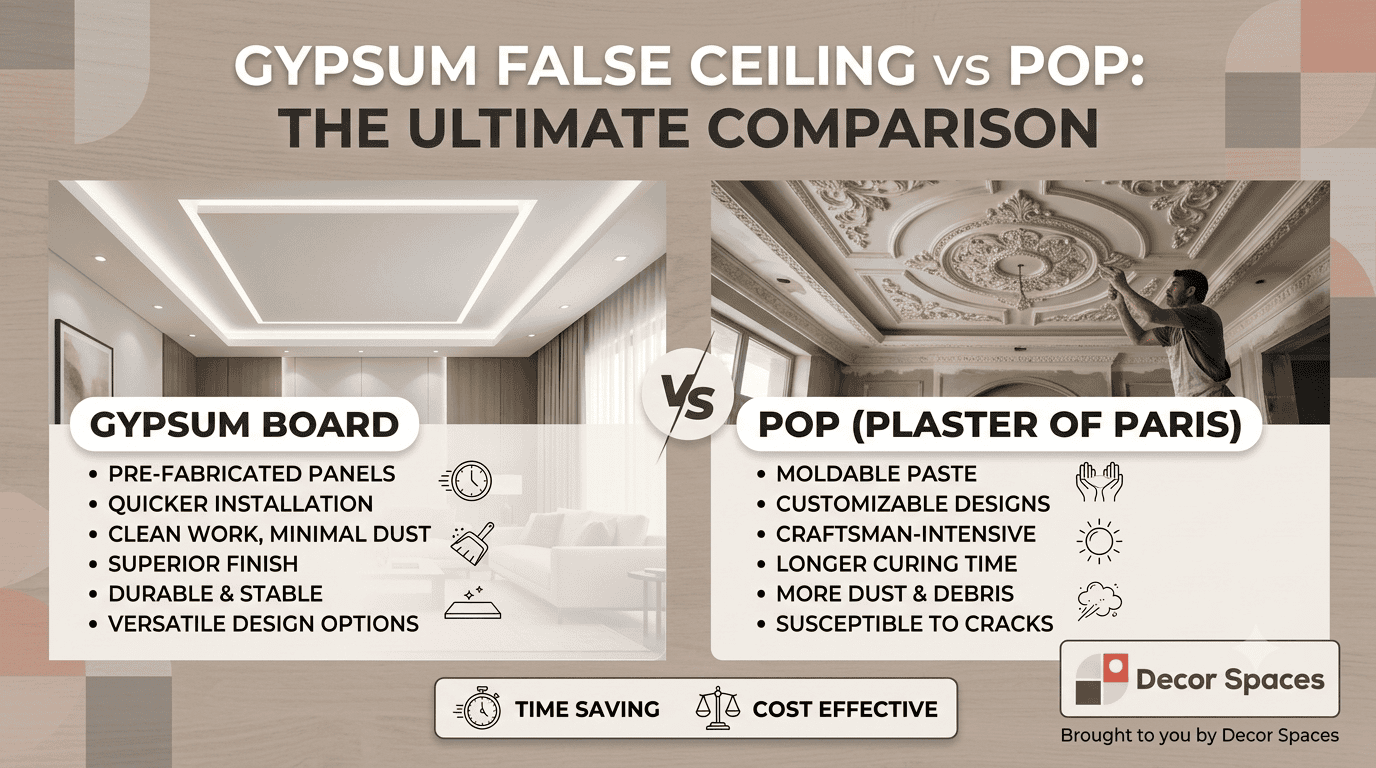
Gypsum False Ceiling vs POP: What’s the Actual Difference?
Working through the gypsum false ceiling vs POP decision starts with understanding what each material actually is. Gypsum false ceiling is built from pre-manufactured gypsum boards, cut to size and fixed onto a metal frame. It arrives as a finished, factory-made panel — you’re assembling boards, not creating a surface from scratch.
POP (Plaster of Paris) ceiling is a wet plaster applied by hand over a wire mesh frame, moulded and shaped on-site. It’s a craft process — the ceiling is sculpted in place, which is exactly why POP can achieve curves, cornices and elaborate mouldings that a flat gypsum board cannot.
Gypsum False Ceiling vs POP: Price Comparison
| Item | Gypsum False Ceiling | POP Ceiling |
|---|---|---|
| Plain/simple design | ₹70 – ₹100/sq ft | ₹60 – ₹90/sq ft |
| Cove lighting design | ₹90 – ₹130/sq ft | ₹85 – ₹120/sq ft |
| Elaborate/moulded design | ₹120 – ₹160/sq ft | ₹120 – ₹180/sq ft |
| Installation time (living room) | 2 – 3 days | 4 – 6 days |
For simple, flat designs POP can actually be marginally cheaper. But once you add cove lighting or elaborate moulding, the labour-intensive nature of POP closes that gap — and gypsum pulls ahead on speed either way.
Want an exact false ceiling quote for your home — gypsum, POP, or a mix of both?
See our false ceiling designs & pricing →Gypsum false ceiling: the case for it
- Faster installation — boards are pre-made; it’s assembly, not wet-craft. A living room ceiling can finish in 2-3 days versus 4-6 for POP.
- Lighter on the structure — gypsum board is significantly lighter than wet plaster, putting less load on the ceiling frame.
- More consistent in humidity. BIS-graded moisture-resistant gypsum board is specifically formulated to resist sagging — a real advantage in Chennai’s coastal humidity, where standard POP can develop hairline cracks over a few monsoons.
- Repairable in sections. Because it’s built from individual boards, a damaged section can often be replaced on its own — you don’t need to redo the whole ceiling.
- Cleaner installation — no wet plaster mess, less curing time, less dust in the home during work.
POP ceiling: the case for it
- Design flexibility. POP is sculpted by hand, so curves, domes, elaborate cornices and continuous flowing shapes are achievable in a way flat gypsum boards can’t match.
- Seamless finish. A well-done POP ceiling has no visible joints — it reads as one continuous surface, which some homeowners prefer aesthetically.
- Familiar to more contractors. POP has been the traditional choice for decades, so it’s easy to find experienced POP labour in most areas.
- Can be marginally cheaper for very simple, flat designs with no lighting cove or moulding.
If your design is simple to moderate — a border design with cove lighting, a stepped ceiling, a plain panel — gypsum wins on speed, weight, humidity performance and repairability. Reserve POP for genuinely elaborate, curved, sculptural designs where its hand-moulded flexibility is the whole point.
What about maintenance and lifespan?
When it comes to gypsum false ceiling vs POP for long-term upkeep, both materials, correctly installed, last well — but they age differently. Gypsum board is more forgiving of Chennai’s humidity swings because the moisture-resistant grade is engineered for exactly this. Standard POP, over many monsoons, is more prone to fine surface cracking as the plaster expands and contracts. Neither is a dealbreaker if installed properly with the right grade of material — but it’s worth explicitly asking your installer whether they’re using moisture-resistant gypsum board, not the standard indoor grade.
Gypsum False Ceiling vs POP: Quick Decision Guide
- Want a fast, low-fuss install with clean edges? Go gypsum.
- Want an elaborate curved or domed design as a centrepiece? Go POP.
- Renovating in humid, older construction? Gypsum, for the moisture resistance.
- Not sure yet? Many homes actually mix both — gypsum board as the base structure with a small POP cornice detail for visual interest. Ask your designer whether a hybrid approach suits your room.
Get a false ceiling quote — gypsum, POP, or hybrid — tailored to your room and budget.
Explore false ceiling designs → Book Free Site Visit →FAQs
Which is better, gypsum false ceiling or POP?
Gypsum is generally better for most Chennai homes — lighter, faster to install, more consistent in humidity, and easier to repair in sections. POP allows more elaborate curved and moulded designs but is heavier, slower, and harder to patch.
What is the price difference between gypsum and POP?
Gypsum typically costs ₹70–100/sq ft for plain designs, POP ₹60–90/sq ft for plain work — but POP rises sharply for elaborate moulded designs, often reaching ₹120–180/sq ft.
Does gypsum false ceiling work well in Chennai humidity?
Yes — moisture-resistant gypsum board handles Chennai’s humidity well and resists sagging better than standard POP over time, provided the moisture-resistant grade is used.
Can gypsum false ceiling be repaired if damaged?
Yes, since it’s installed in board sections, a damaged section can often be replaced individually. POP is a continuous plaster surface, so damage usually needs a larger patch area reworked.
Related reading: False ceiling designs & pricing · 2 BHK interior cost breakdown · 3 BHK interior cost breakdown
Planning your interior work?
Free site visit, 3D design, and an itemised quote — no obligation.